
Photography Reflection by Joe Schad, SJ
I was introduced to photography with a Christmas gift of a Kodak box camera when I was 12 years old. In those days, most standard photos were black & white. When the yellow envelope of dated, deckle-edge, newly developed images were returned in the mail, it was hit or miss. Some were out of focus, others under or over or under-exposed, yet a few emerged perfectly clear. The experience of ‘capturing’ a time and place was new and exciting for me.
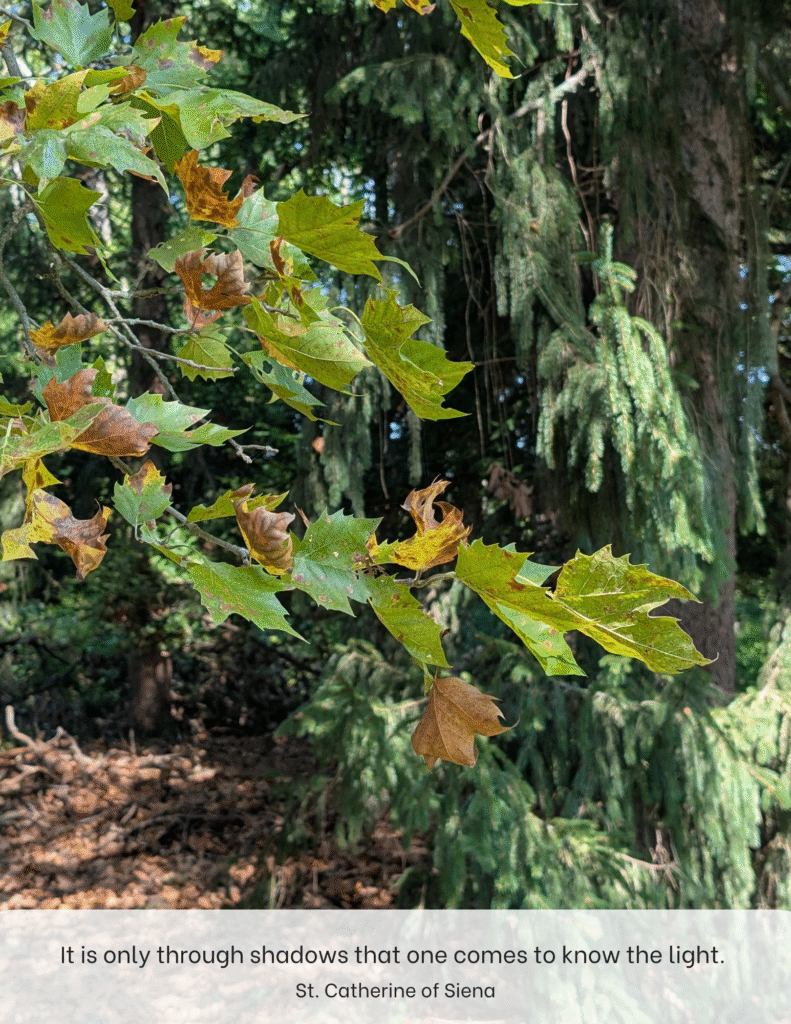
Later, I began to notice the intriguing interplay of light and dark. I realized that without areas of shadow, those areas of brightness would not stand out. As St. Catherine of Siena reminds us, “It is only through shadows that one comes to know the light.”
I also appreciated the contrast between in-focus foregrounds and slightly out-of-focus backgrounds. This contrasting dynamic resulted in a sense of depth and almost three dimensionality, which could bring a photo to life. The final realization was how photography could both stop motion or render a moving object intentionally blurred, according to the chosen speed of the shutter or size of the aperture.
When beginning my studies in the creative arts at RISD – the Rhode Island School of Design - I chose to major in photography and film. It was here that I learned the basics of composition, form and style. I also was taught how to develop my own images in a darkroom. With professional instruction from insightful, world-renowned teachers, along with honest critiques of my work, I was able – over time - to fine-tune my efforts.
My photographs then were focused portraiture and close-ups of architectural details. For my final project, I studied the lighting in the paintings of classic artists and began to explore how to translate their subject matter and techniques into photographic images.
After graduation, I, unfortunately, found few opportunities to utilize my photographic talents. However, some years later, I was invited, as a volunteer with Peace Corps, to work in Oman, in Arabia. I was assigned to the Ministry of National Heritage, creating a photographic archive of archeological sites in the country.
On my return, I applied and was accepted into the Jesuits. One important spiritual epiphany, which evolved for me in those early years in the Society of Jesus, was seeing a connection between my understanding of the interplay of light and dark, as being complimentary, and a contemplation of the mystery and integral nature of the Crucifixion and Resurrection. The radiance of Resurrection cannot exist without the darkness of Crucifixion and Crucifixion is meaningless without Resurrection. The two events of our faith history are intimately interconnected. As a result of this realization, my appreciation and love of the nature of photography further crystalized and informed my faith journey.
Presently, I have chosen not do much personal photography. However, when asked, I enthusiastically take up my trusty Nikon yet again and immerse myself in the art of photography. I do miss not being able to develop my negatives within the traditional processes, transforming celluloid strips of reverse imagery, into photos which emerge from the dark in the chemical bath, each image gradually appearing almost like magic. Now, of course, everything is digital and so, that ‘magic’ is gone.
I recently offered a workshop on the photography of Thomas Merton here at the Center. I presented a short history of Merton’s photographic philosophy and visual subject matter, grounded in his spirituality and love of nature, along with some examples of his photos. This was followed by an exercise to capture images here on the grounds of St. Raphaela Center, in the spirit of Merton. I was in awe of the results. They were simple -yet profound - images, which reflected intimate, personal experiences of God’s presence.
This quote from Thomas Merton, I believe beautifully expresses some of my own thoughts on photography, in the context of my spirituality. “The camera does not know what it takes: it captures materials with which you reconstruct not so much what you saw as what you thought you saw. Hence the best photography is aware, mindful, of illusion and uses illusion, permitting and encouraging it—especially unconscious and powerful illusions that are not normally admitted on the scene.”
This perspective is found in the title of collection of photographs by Merton entitled, ‘A Hidden Wholeness’, based on a quote by him: “There is in all visible things an invisible fecundity, a dimmed light, a meek namelessness, a hidden wholeness. This mysterious Unity and Integrity is Wisdom, the Mother of all, ‘Natura Naturans’. There is in all things an inexhaustible sweetness and purity, a silence that is a fountain of action and of joy. It rises up in wordless gentleness and flows out to me from the unseen roots of all created being...”
This perspective also reflects the Ignatian theme of “finding God in all things.” Through our presence with and attentiveness to all around us, we can come to know God more fully, through God’s ongoing Creation.
Photography can be one means of achieving this vision. It can reflect our interests and love for Nature and an appreciation of all God has created. The invitation is there – let those photos you take with your cameras or cell phones represent your experience of God in your everyday life. God is everywhere, if only we take the time to look!
Joe Schad, SJ, is a Spiritual Director on staff at St. Raphaela Center. He is originally from South Philadelphia and attended St. Joe's Prep, where he first encountered the Jesuits. He graduated from the Rhode Island School of Design (RISD), with a BFA in the graphic arts program. Afterwards, Fr. Joe spent most of a year discerning his vocation at a Trappist monastery in North Carolina. Following two years with Peace Corps, he worked in JVC as a crisis counselor. He entered the Society of Jesus 44 years ago and has just celebrated 33 years as a Jesuit priest. His formation studies were at Gonzaga and the Jesuit School of Theology (JSTB) in Berkeley, where he focused on Rahner and Narrative Theology. After ordination, Fr. Joe was assigned to Fairfield University, where he taught media studies and later joined the Campus Ministry team. He completed his Tertianship in Australia, as a prelude to Final Vows. He then was named Pastor at St. Leonhard Parish in Frankfurt, Germany. On his return, he received certification as a spiritual director from the Center of Religious Development (CRD) in Cambridge and was missioned to the Holy Spirit Retreat Center, in Anchorage, AK. In preparation for assignment as a chaplain, Fr. Joe completed his clinical practice training at Loyola University Medical Center. For over 16 years, initially at Mercy Hospital in Portland, then later at Georgetown University and St. Vincent's Medical Center in Bridgeport, CT., he offered pastoral presence and support to patients and their families. Throughout these years, Fr. Joe has provided individual spiritual direction, as well as, facilitating retreats and days of reflection, focusing on Ignatian Spirituality and Centering Prayer. He has studied Zen Buddhism, as well as, other world religions. His personal interests include collecting rare illustrated books and prints, traditional music and travel.