A Reflection on the Power of the Arts and Spirituality by Becky McIntyre
You can watch Becky's reflection here.
In the spring of 2024, I moved into St. Raphaela Center as the first Artist-in-Residence. At the time, the program was a new exploration of one of the center’s focuses on connecting the arts, our senses, and spirituality. Just before I moved in we celebrated and blessed the newly created art studio in the House of Hope, a dream realized by Jackie Newns with the help of others, and Jackie had launched the first season of Art and Spirituality workshops. As I was leaving my job and transitioning into a season of doing art full-time, Jackie and I dreamed up this program, which for me was a natural fit for my participatory art practices and my relationship with the Handmaids and center since 2013.
After months of building with this beloved community of wonderful staff, sisters, and volunteers in this place, I wanted to find a way to thank everyone in a meaningful, individual and collective way. I wanted to gift something to the Center and Handmaids as a whole to symbolize their story, but also have something that each individual I had encountered here could enjoy and relate to that captured a piece of the present reality of this place and community.
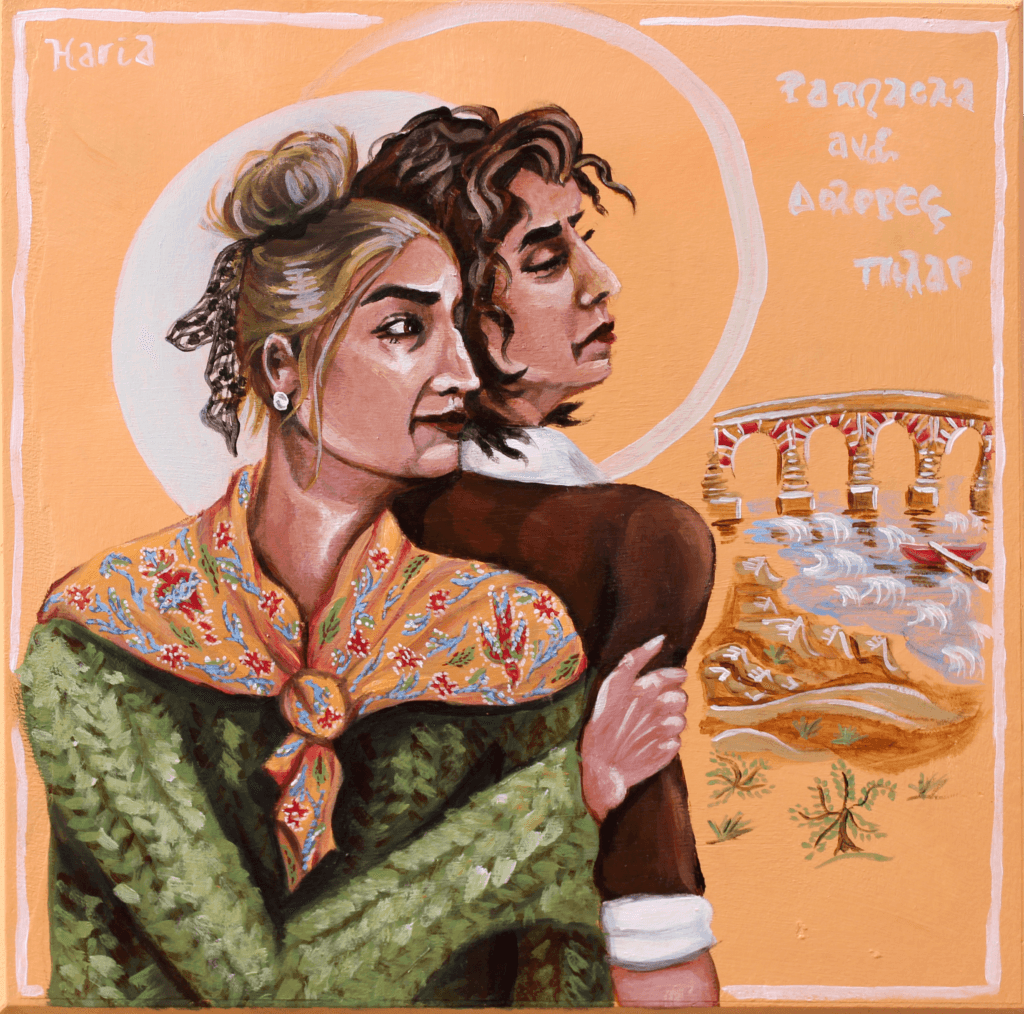
So as a thank you to the wonderful staff of the center for that experience and as a gift for the over 10 years of relationship and generous support that the sisters have provided me with, I commissioned this image of St. Raphela and her biological sister Dolores, who co-founded the community, by Gracie Morbitzer of Modern Day Saints by Gracie. I decided that creating a “modern day” St. Raphaela would be the perfect combination of what I was looking and hoping for.
I want to reflect a bit on why I chose this gift and why symbols and the arts are important to how we live and experience and relate to our faith. I often come back to a moment before I moved in when Steven, Head Chef here at St. Raph’s, looked at my synodal art on the wall that captured the voices of almost 400 students from Catholic colleges, universities, and Newman centers across the Archdiocese of Philadelphia and said to me, “Thank you for making these images. They have been really impactful for my daughter and capture the Church that she envisions and has difficulty articulating to people who don’t.”
Seeing what we envision validated through art helps us to recognize God at work in creation and inspires us to use our own creativity in responding to God’s call to be practitioners of hope in living out the world that we imagine. It helps us to be co-creators in God’s dream and reminds us to find the beauty within ourselves and our world that is full of pain. This is why I value so much the people, including many at this center, who have nurtured and nourished my own creative call and why I know how much the arts matter to those who may not see themselves as artists. The arts are an important and direct way for us to connect to the divine. They put us into relationship with our senses, which put us into a tactile, embodied, and direct connection with the Creator, the Ultimate Artist, the God of Beauty. In that vein, it is important to have symbols and imagery and art that we feel connected to, that we can see ourselves in, and that feel relatable.
On her website, Gracie writes:
“Ancient icons of saints portray everyone as old, white, expressionless, and hard to tell apart. While this is part of a long tradition that has its merit, I believe that it can make the saints unrelatable… My goal was to re-imagine these extraordinary people as modern, everyday humans... because that is exactly what they were, and their stories are just like ours. They show us that we can all be saints, and can find role models and hope in the story of someone who has gone through what we are going through before us. The saints experienced every emotion, trial, and joy that we can experience, but they also reached beyond themselves and made their lives and communities so much better and more full of love.”
A symbol is defined as, “something real that stands for or suggests another thing that cannot in itself be pictured or shown.” Recently the group of young adult associates met with Sr. Jessica to talk about the sacred heart, the pierced heart of Christ. Jessica said that the heart is the center of our human and spiritual experiences - it’s not just a physical organ or our emotional being, but the totality of who we are. The ultimate symbol of Jesus’ reality as God incarnate, not just his emotions or organs. It is unity of body and soul, God’s love poured out for us until the end for all. And we use the symbol of a heart because we can’t visually articulate the totality of the human experience. During this reflection, it made me annoyed that we reduce this ultimate reality, this totality of life, to a tiny 2-humped shape clip-art outline. Now of course this little shape is used to represent a lot of things so we might need different symbols for different moments and not everyone is looking to dive into the totality of life itself when they text the greater than sign with a number 3 to a friend, but I thought about how it’s important to have different symbols that allow us to enter into the greater reality of things as we ponder them. That’s why the arts matter.
An image cannot capture the all of a human person or an experience. It can’t capture the totality of a person’s emotions, thoughts, experiences, mysteries, will, desires, intellect and so on. But it’s a moment frozen in time where we can get a piece of the puzzle that invites our imaginations into more. We’ll never know the complete Raphaela, but this image, for some, might get us a step closer. I know that personally I don’t always know how to connect to the black-and-white image of Raphaela in a habit, often looking stoic. But from the stories I’ve heard and read, I’m sure Raphaela felt pain and grief and cried and got angry. But she also prioritized relationship and dialogue and celebration and reparation with her sister Dolores and her community. As we take a moment to think about how all of these emotions show up in our own lives, we know that it was messy and human. Art helps make our faith relatable to our lives. Some who may not have been able to see themselves in other images of Raphaela now may be able to relate to her in a new way. It doesn’t mean that other symbols and images haven't or won’t work for others, but I know that this image captures someone who I can relate to so I hope that this image might do the same for others too. For me, I also think that portraying Raphela in this modern way is a nod to all of the staff and sisters at the center who live Raphaela’s values today, day in and day out - the folks that helped me make a home here (thank you to each of you).
I asked the sisters for some references of what they would like to see in the image, and it was suggested that in this time, when reconciliation is so deeply needed, that Raphaela and Dolores, the two co-foundresses of the Handmaids and also biological sisters that had had a relationship full of conflict and challenges, but also reconciliation, be portrayed together. This relationship is at the root of the Handmaid charism of reparation. The two of them together represent pain and division, but also forgiveness and healing. They were very different people but were able to overcome their adversity and conflict to repair their relationship. This is what we need to be reminded of today, in these current times, too, which makes this image even more relevant. The sisters called Raphaela and Dolores the foundation stones - battered but foundational, with “their ability to reconcile, and their clearsightedness to do what it took for the good of the congregation out of their love for it, no matter how challenging...this is our authentic and solid foundation.” And of course this foundation gets its strength in the Eucharist, in the sisters’ theology of the torrent of love coming from the pieced heart of Jesus. The sisters also shared Raphaela’s quote (translated from it’s original Spanish, “Do everything for peace” and Dolores’s quote also translated, “Row against all odds. Sing in the midst of the storm. The one who guides us is very steady and will always help us.” All of these pieces, synthesized by Gracie, are the touchstones represented in this image that capture the charism and foundation of the Handmaids and the ACI family and ministries.
Gracie describes the image with the following:
“I just want to say that this was such a joy to create. I pored over all the materials you sent me - it was so fascinating to hear such a human story about these saints. I love how different they were from each other, and yet how dedicated they were in their own ways! The colors come from the art and architecture of their time and region in Spain, and I used the photo references of the actual women as part of my inspiration. Because of Raphaela’s love of and work in embroidery, she wears an embroidered shawl featuring the sacred heart bleeding and a dove on the other side for the Holy Spirit. Her hair ribbon is black lace much like the veil Dolores is shown wearing in her photographs, and her clothing is similar also with the white collar. Though they are back to back and not looking at each other, Raphaela reaches out to her sister’s arm as a symbol of repair. In the background, in a very traditional iconographic style, is the image of a bridge that combines an actual bridge in Cordova with the Spanish arches that are so recognizable. The foundations of that bridge are large and strong and ancient, and I know both the bridge and stones are important symbols to the Sisters. The water in front of it also has waves, symbolizing a storm, and a boat on it to incorporate Dolores’ quote about rowing through the storm. Lastly, there is small greenery on the hillside near it, symbolizing new life out of the parched dirt.”
Art helps us break down barriers, amplifies empathy and multiple perspectives, and pulls us into stories - connecting Raphaela and Dolores’ story to our own. It is accessible and tangible, moves us beyond words to open us up in different and more embodied ways, and helps us to engage with people and to understand familiar ideas and in new and different ways. It helps us to transform culture. Art is a fuller entry point to going into a deeper reality that is complicated and can’t fully be expressed in words. It can help us deepen our reflection and synthesis and prayer. Although sometimes I think it’s too much, that’s part of why our tradition and rituals and churches are full of all of the bells and whistles - imagery and colors and icons and incense and flowers and so on. Art awakens us to what the spirit is prompting in each of us and expands our capacity to imagine living it together. I hope people will continue to find ways to explore the arts as an expression of spirituality and an avenue for connecting with the divine and their faith here at the Center, and can find a new entry point for relating to Raphaela through this image.
You can join us on Sunday to celebrate the feast of Raphaela and for the full reveal and blessing of the image.
This reflection was shared during Taizé prayer and adoration on May 13, 2026.